What to Watch Out for When Selling Real Estate During Marriage?

Selling property during marriage requires checking whether it forms part of the spouses’ joint property and whether the other spouse’s consent is required. A sole owner entry in the land register is not always decisive, and consent may also be needed for separately owned property used as the family home. The article explains the correct sale process and the risk of the purchase agreement being challenged.

Key takeaways
What does the Land Registry record show?
But beware! If you or only your spouse are listed as the owner in the Land Registry, you cannot automatically conclude that the property is not part of the joint property of spouses (SJM) based on this record. In such a case, it is necessary to further examine whether the property, despite such a record in the Land Registry, does in fact fall under the SJM.
Does the property actually fall under the SJM?
To assess whether a property is in the exclusive ownership of one of the spouses or falls under the SJM, it is first necessary to assess on what legal basis and at what time the spouse acquired the property.
If a spouse acquired the property before entering into the marriage, and the SJM was not extended to include this property during the marriage, then it is in the exclusive ownership of that spouse. The same will be true if the spouse acquired the property through inheritance or a gift agreement, regardless of whether they were already married or if it happened before the marriage.
If a spouse acquired the property based on a purchase agreement after entering into the marriage, then unless it falls under statutory exceptions, such property will be part of the SJM, even if only one of the spouses concluded and signed the purchase agreement.
Procedure for selling
1. The property is not in the SJM
If the property you want to sell is not in the SJM, it does not mean that there is nothing else to address and that the property can be sold without any involvement of your spouse. First, it is necessary to consider whether a family household exists in the property that is not in the SJM (for more on this topic, see our separate article, available here).
In short, we can state that if there is no family household in the property being sold, you can conclude the purchase agreement and sell the property without your spouse's consent and involvement. If a family household did exist there, it would be essential for your spouse to give consent to the sale of the property, or ideally, to also sign the purchase agreement with you as an accessory party.
2. The property is in the SJM
If the property is part of the SJM, then the involvement of your spouse is, of course, essential. In such a case, this will be a so-called non-routine matter (for more on this topic, see our separate article, available here), for which you need your spouse's consent.
The ideal procedure should be that you both sign the purchase agreement on the seller's side – both you and your spouse. If, for example, the purchase agreement has already been signed and the spouse was left out of the process, it will be necessary to obtain the spouse's written consent to the sale of the property, or rather, to the conclusion of this specific purchase agreement.
Otherwise, the spouse could in the future dispute the validity of the concluded purchase agreement, which could cause significant problems for both you and the person who bought the property from you (especially if the buyer financed the purchase with a mortgage loan). In such a case, you could also face a great risk that the buyer would claim damages from you that arose as a result of your incorrect procedure.
Conclusion
As is clear from the above, even selling a property is not as straightforward and simple as it might seem at first glance. It is therefore always advisable to consult everything with an expert so that an incorrectly chosen procedure cannot lead to situations that would mean considerable problems in the future for both you and the buyer.
As a rule, the costs of having a professional assess the matter and prepare the contractual documentation are only a fraction of the potential costs that can arise if a problem occurs. By establishing the correct procedure and having the contractual documentation prepared by a professional, you can prevent future worries and costs, both financial and time-related.
From the buyer's side, it is also always advisable to check, within their means, whether the property they intend to buy belongs to the seller's SJM, at least by checking the acquisition title, which can be obtained from the relevant Land Registry.
Family, Business, Assets: How to ensure you don't neglect anything? – We have prepared a webinar for you where you will learn what to watch out for!
Why choose us?
Family and property relationships can be complex, whether it involves protecting family assets, inheritance, or running a family business. With us, you get clear and effective solutions that will help you prevent legal complications and protect your values.
What do we bring you?
Legal certainty for your family and business – we will help you with adjusting property relations, inheritance issues, prenuptial agreements, and setting up family businesses so that everything is in line with your ideas and legal standards.
Understandable and practical solutions – with us, you don't have to worry about complex legal formulations. We prepare documents and proposals to be clear, concise, and easy to apply in practice.
Prevention of legal risks – we help you prevent disputes and ambiguities that could threaten your family relationships or business.
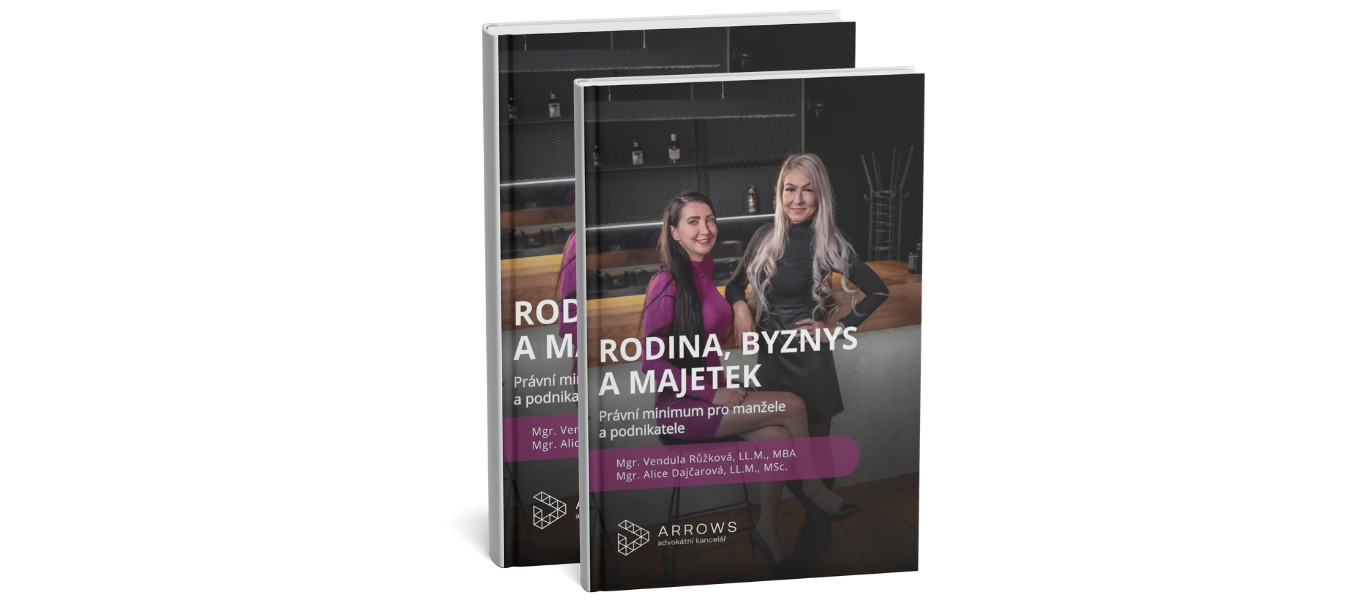
We know that legal issues related to family and assets can be demanding and time-consuming. That's why we have prepared the e-book Family, Business, and Assets, which will provide you with practical advice and instructions on how to correctly set up legal processes and protect your assets and future.
In the e-book you will find:
✅ Practical advice, for managing family assets and business.
✅ An overview of the most common legal mistakes and how to avoid them.
✅ A sample of our approach:, how we convey expert legal knowledge simply and understandably.
Protecting assets and family relationships doesn't have to be complicated. We will help you set everything up to be safe, effective, and sustainable in the long term.
Don't want to solve this problem on your own? We are trusted by more than 2,000 clients and have been awarded Law Firm of the Year 2024. See HERE our references.
About the author
Disclaimer:
The information contained in this article is for general informational purposes only and serves as a basic guide to the issue as of 2026. Although we strive for maximum accuracy, laws and their interpretation evolve over time. We are ARROWS Law Firm, a member of the Czech Bar Association (our supervisory authority), and for the maximum security of our clients, we are insured for professional liability with a limit of CZK 350,000,000. To verify the current wording of the regulations and their application to your specific situation, it is necessary to contact ARROWS Law Firm directly (consultation@arws.cz). We are not liable for any damages arising from the independent use of the information in this article without prior individual legal consultation.